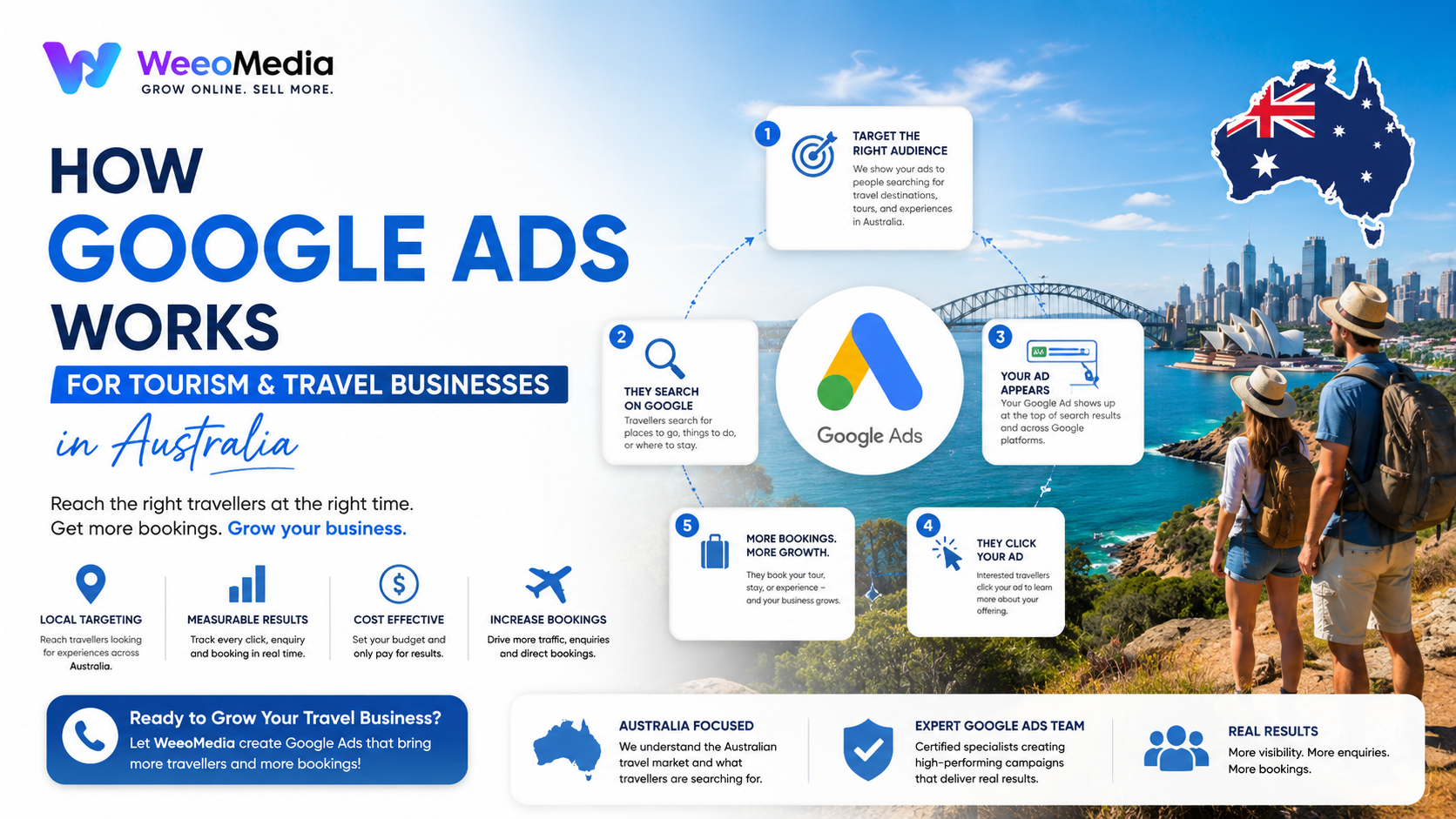
Australia's tourism and travel industry is one of the most dynamic and competitive digital markets in the country. Whether you operate a coastal sailing tour in Queensland, a wine trail experience in the Barossa Valley, a luxury lodge in the Northern Territory, or a family adventure camp in Victoria, the challenge is always the same. You need to reach the right traveller at the right moment, before they book with someone else.
Google Ads gives travel and tourism businesses in Australia the ability to do exactly that. Unlike organic SEO, which builds visibility over months, Google Ads for travel businesses in Australia delivers immediate placement at the top of search results the moment a potential customer is actively searching for what you offer. When someone types "best reef snorkelling tours Cairns" or "guided outback tours Australia" into Google, your ad can appear instantly, above organic results, putting your business in front of a high-intent audience at the most critical point in their decision-making process.
This blog explains how Google Ads works, which campaign types are most effective for tourism and travel businesses in Australia, how to structure campaigns for maximum return, and what common mistakes to avoid.
What is Google Ads and How Does it Work
Google Ads is Google's online advertising platform that allows businesses to display paid advertisements across Google Search, Google Maps, YouTube, Gmail, and millions of websites within the Google Display Network. Advertisers bid on keywords, and when a user's search matches those keywords, the ad is eligible to appear. Advertisers pay only when someone clicks on the ad, which is why Google Ads operates on a Pay-Per-Click model.
For travel and tourism businesses, the platform is particularly powerful because it allows you to target people based on what they are actively searching for, where they are located, the device they are using, the time of day, and even their past travel-related browsing behaviour. This level of targeting precision means your advertising budget is directed toward people who are genuinely interested in booking a travel experience, not a broad, unqualified audience.
Pay-Per-Click advertising for tourism in Australia operates in a real-time auction. Every time a user performs a search that matches your chosen keywords, Google runs an instant auction to determine which ads appear and in what order. Your ad's position is determined not just by how much you bid, but also by your Quality Score, which measures the relevance and quality of your ad, your keywords, and your landing page. A well-optimised campaign with a high Quality Score can achieve top ad positions at a lower cost per click than a competitor with a higher bid but poorer relevance.
Why Google Ads is Particularly Effective for Australian Travel Businesses
Several characteristics of the Australian travel market make Google Ads an exceptionally strong channel for tourism operators and travel agencies.
High online booking intent: Australian and international travellers are highly digitally engaged. Research by Tourism Australia and Google consistently shows that travellers use search engines at multiple stages of the planning process, from initial inspiration through to final booking confirmation. Google Ads places your business in front of this audience at every stage.
Seasonal demand capitalisation: The Australian travel industry operates in strong seasonal cycles. The dry season in tropical Queensland, summer school holidays, Easter breaks, and the ski season in the Snowy Mountains all create predictable spikes in search demand. Google Ads campaigns can be scheduled and budgeted specifically around these peak periods, allowing you to increase spend when demand is highest and reduce it during quieter months.
Targeting international visitors: Australia's inbound tourism market includes significant visitor volumes from the United Kingdom, United States, China, Japan, Germany, and India. Google Ads allows you to target users in specific countries, speaking specific languages, searching for Australian travel experiences. This capability is invaluable for tourism businesses that rely on international visitors for a significant portion of their revenue.
Direct booking capability: One of the most significant advantages of Google Ads for Australian tour operators is the ability to drive traffic directly to your booking page, bypassing commission-heavy OTA platforms entirely. Every direct booking you secure through your own website saves you the 15 to 30 percent commission that OTAs typically charge.
Types of Google Ads Campaigns for Tourism and Travel Businesses
Not all Google Ads campaign types are equally suited to travel and tourism marketing. Understanding which formats work best for different objectives is key to building an effective strategy.
Search Campaigns
Search campaigns are the most fundamental and widely used format for travel businesses. These are the text-based ads that appear at the top of Google search results when a user types in a relevant query. For tourism operators, search campaigns are ideal for capturing high-intent bookings from travellers who are actively searching for specific experiences, destinations, or tour types.
Search campaign strategies for travel businesses should be built around tightly themed ad groups, with each group targeting a specific cluster of related keywords. For example, one ad group might target reef diving tours in Cairns, another might target Great Ocean Road tours from Melbourne, and another might target family wildlife experiences in South Australia. Each ad group should have its own tailored ad copy and a dedicated landing page that directly matches the search intent.
Responsive Search Ads, which are now the standard format in Google Search campaigns, allow you to provide multiple headline and description variations that Google automatically tests and combines to find the highest-performing combinations for different users and searches.
Performance Max Campaigns
Performance Max is Google's newest and most automated campaign type. It uses machine learning to serve ads across all Google channels simultaneously, including Search, Display, YouTube, Gmail, Google Maps, and Discover, from a single campaign. You provide Google with creative assets, audience signals, and conversion goals, and the system optimises delivery across all channels to maximise your specified objective.
For tourism businesses with strong visual assets, compelling destination photography, and video content, Performance Max can be highly effective. It is particularly well suited for businesses looking to reach travellers across multiple touchpoints throughout their planning journey, from early-stage inspiration on YouTube through to late-stage booking intent on Search.
Display Campaigns
The Google Display Network reaches users across millions of websites, apps, and Google-owned properties. Display ads for travel businesses use high-quality imagery of destinations, experiences, and properties to capture attention and build brand awareness among users who may not yet be actively searching but who fit the profile of your ideal traveller.
Display campaigns are particularly effective for remarketing, which means showing ads to users who have previously visited your website but did not complete a booking. Remarketing ads for tourism businesses keep your brand visible and top of mind as travellers continue their research across the web, significantly increasing the likelihood of them returning to your site to complete a reservation.
YouTube Ads
Travel is one of the most visual categories of consumer interest, and YouTube is one of the world's most powerful platforms for travel inspiration. YouTube ads allow tourism businesses to reach travellers during the dreaming and planning stages of their journey with compelling video content showcasing your destinations and experiences.
Skippable in-stream ads, non-skippable ads, and bumper ads can all be targeted based on travel-related interests, search history, demographics, and geographic location. A well-produced 30 to 60 second video ad showcasing a helicopter tour over the Kimberley or a sunset sailing experience on Sydney Harbour can create powerful emotional engagement that drives both direct clicks and branded search volume.
Google Hotel Ads
For accommodation businesses specifically, Google Hotel Ads is a highly effective campaign type that displays your property and rates directly within Google Search and Google Maps results. When a traveller searches for hotels in a specific location, Google Hotel Ads shows a comparison panel with available properties, dates, and prices. Appearing in this panel drives highly qualified clicks from travellers who are at the final stage of booking decision.
Keyword Strategy for Travel Google Ads Campaigns
Keyword selection is one of the most important factors in determining the success or failure of a Google Ads keyword strategy for travel businesses. Choosing the wrong keywords wastes budget on irrelevant traffic. Choosing the right keywords connects you with travellers who are ready to book.
Destination and activity keywords: These are the core of most travel search campaigns. They combine a location with an activity or experience type, such as "snorkelling tours Whitsundays," "hot air balloon ride Hunter Valley," or "Aboriginal cultural tours Uluru."
Branded keywords: Bidding on your own brand name ensures you appear at the top of results when someone searches for your business specifically, protecting your brand from competitors who may bid on it.
Competitor keywords: Bidding on competitor brand names is a common and generally accepted practice in Google Ads. It allows you to appear when someone searches for a competitor, potentially capturing a traveller who is still in the comparison stage.
Long-tail keywords: Longer, more specific search phrases like "small group luxury tour Blue Mountains private" indicate very high booking intent and typically have lower competition and cost per click than shorter, broader terms.
Negative keywords: These are equally as important as your positive keyword list. Adding irrelevant terms as negative keywords prevents your ads from appearing for searches that are unlikely to result in a booking, saving budget and improving your campaign's overall efficiency.
Writing Effective Ad Copy for Travel and Tourism Campaigns
Compelling ad copy is what converts a search impression into a click. For tourism businesses, ad copy needs to communicate the unique appeal of your experience, create a sense of excitement or desirability, and provide a clear reason to click and book now rather than continue researching.
Strong travel ad copy typically highlights the unique selling proposition of the experience, includes a specific location or destination name for relevance, uses action-oriented language that encourages immediate engagement, mentions trust signals like years in operation, award recognition, or review ratings, and includes a compelling call to action such as "Book Your Tour Today," "Reserve Your Spot," or "Check Availability Now."
Ad extensions, now known as assets in Google Ads, significantly improve the visibility and performance of travel ads. Sitelink assets allow you to show additional links to specific pages like individual tour types or booking pages. Callout assets highlight key selling points like "Small Groups," "Family Friendly," or "5-Star Rated." Location assets show your business address and link to Google Maps, which is particularly useful for tours departing from a specific location.
Landing Pages for Travel Google Ads
Sending paid traffic to your homepage is one of the most common and costly mistakes travel businesses make with Google Ads. Every ad click should land on a dedicated page that is specifically designed to match the intent of the search query and guide the visitor toward completing a booking.
An effective landing page for a travel Google Ads campaign clearly communicates the specific experience or destination the visitor searched for, includes high-quality photos or video that brings the experience to life, provides a clear and simple booking or enquiry process, displays social proof through guest reviews and testimonials, addresses common questions or objections, and loads quickly on both desktop and mobile devices.
The relevance between your keyword, your ad copy, and your landing page also directly influences your Quality Score, which in turn affects both your ad position and your cost per click. A highly relevant landing page experience can meaningfully reduce your advertising costs while improving your conversion rate simultaneously.
Budgeting and Bidding for Australian Travel Campaigns
Google Ads budgeting for tourism businesses requires careful planning, particularly given the seasonal nature of travel demand and the varying cost per click across different destinations and experience types.
Average cost per click in the Australian travel and tourism sector varies widely depending on competition and keyword specificity. Broad, high-competition terms like "tours Australia" can command very high cost per click rates, while specific long-tail terms like "three-day Flinders Ranges tour" may cost a fraction of that. Structuring your campaigns around specific, targeted keywords rather than broad, generic ones is the most effective way to maximise the value of your advertising budget.
Smart bidding strategies, including Target ROAS (Return on Ad Spend) and Maximise Conversions, use Google's machine learning to automatically adjust bids in real time based on the likelihood of conversion. For travel businesses with strong conversion tracking in place, smart bidding can significantly improve campaign efficiency over manual bidding.
Campaign scheduling allows you to increase bids during peak search hours and reduce spend during times when your target audience is less active, further optimising budget allocation.
Measuring Success in Travel Google Ads Campaigns
Effective measurement is what separates profitable Google Ads campaigns from those that drain budget without clear return. For tourism businesses, the most important metrics to track include:
Conversion rate, which measures the percentage of ad clicks that result in a booking, enquiry, or other desired action. Cost per conversion, which tells you how much you are spending on average to acquire each booking or lead. Return on Ad Spend, which measures the revenue generated for every dollar spent on advertising. Click-through rate, which indicates how compelling your ad copy is relative to the searches it appears for. Quality Score, which reflects the overall relevance and health of your keywords, ads, and landing pages.
Setting up conversion tracking correctly is essential. For travel businesses, conversions typically include completed online bookings, booking enquiry form submissions, phone calls generated from ads, and email clicks. Without accurate conversion tracking, it is impossible to know which keywords, ads, and campaigns are delivering real business value.
Common Google Ads Mistakes Made by Australian Travel Businesses
Even well-intentioned Google Ads campaigns can underperform if certain common mistakes are not avoided.
Targeting keywords that are too broad results in ads appearing for irrelevant searches that waste budget and deliver no bookings. Using broad match keywords without sufficient negative keyword lists is a frequent cause of this problem.
Sending all traffic to the homepage rather than dedicated, experience-specific landing pages reduces conversion rates and inflates cost per acquisition.
Ignoring mobile performance is a critical error in travel advertising. The majority of travel searches in Australia now happen on mobile devices. Ads and landing pages that are not optimised for mobile will underperform significantly.
Setting and forgetting campaigns without regular monitoring and optimisation allows underperforming keywords and ads to continue consuming budget without delivering results.
Not using ad extensions reduces the visibility and click-through rate of ads, giving up valuable real estate in search results that competitors will gladly occupy.
Failing to segment campaigns by destination, experience type, or audience results in broad campaigns that are difficult to optimise and analyse effectively.
Combining Google Ads with SEO for Maximum Results
While Google Ads and SEO for Australian tourism serve different purposes and operate on different timelines, they are most powerful when used together as part of an integrated digital marketing strategy.
Google Ads delivers immediate visibility and allows you to test keywords, messaging, and landing pages quickly. The data gathered from a well-run Google Ads campaign provides invaluable insights for your SEO strategy, revealing which keywords convert, which messages resonate, and which destinations or experiences attract the highest value travellers.
SEO, in turn, builds the long-term organic authority that reduces your dependence on paid advertising over time. Businesses that invest in both channels simultaneously benefit from maximum search visibility, with paid ads capturing high-intent searches in the short term while organic rankings build sustainable, cost-free traffic for the future.
Frequently Asked Questions
How quickly can Google Ads generate bookings for my travel business in Australia?
Google Ads can generate clicks and bookings almost immediately after a campaign goes live, sometimes within hours of launching. This makes it one of the fastest ways to drive traffic and reservations for a travel business, particularly when launching a new service, promoting a seasonal offer, or filling last-minute availability. However, campaign performance typically improves significantly over the first 4 to 8 weeks as data accumulates and optimisation takes effect.
How much should an Australian travel business spend on Google Ads?
There is no fixed minimum, but most tourism businesses in Australia need a meaningful monthly budget to generate sufficient data for optimisation and to compete effectively in their target markets. The right budget depends on your destination, the competitiveness of your target keywords, your average booking value, and your desired volume of bookings. A specialist travel Google Ads consultant can model appropriate budget levels based on your specific business objectives.
What types of tours and travel experiences work best with Google Ads?
Google Ads works well for virtually any type of tour or travel experience that has sufficient search demand. It is particularly effective for experiences with high average booking values, clear geographic specificity, strong seasonal demand peaks, and compelling visual stories that can be communicated through ad copy and landing page imagery. Day tours, multi-day adventures, luxury experiences, family activities, and corporate retreats are all well-suited to Google Ads campaigns.
Should I use Google Ads or SEO for my tourism business?
Both channels serve distinct purposes and deliver different types of value. Google Ads provides immediate, controllable visibility that is ideal for seasonal promotions, new experience launches, and filling short-term booking gaps. SEO builds long-term organic authority that delivers compounding traffic growth over time without ongoing cost per click. The most effective strategy for most Australian tourism businesses combines both, using Google Ads for short-term performance and SEO for sustainable long-term growth.
Can Google Ads help me attract international tourists to Australia?
Yes, absolutely. Google Ads offers sophisticated geographic targeting that allows you to show ads specifically to users in other countries who are searching for Australian travel experiences. You can target individual countries, regions within countries, or even users in specific cities who represent your ideal international visitor profile. Combined with language targeting and tailored ad messaging, this makes Google Ads a powerful tool for reaching inbound tourism markets.
What is remarketing and how does it help my travel business?
Remarketing allows you to show targeted ads to people who have previously visited your website but did not complete a booking. In travel, where the booking decision often takes days or weeks and involves multiple research sessions, remarketing is extremely valuable. It keeps your brand visible as potential guests continue their research, increasing the likelihood of them returning to your site to confirm their booking rather than choosing a competitor they encountered during their research.
How do I know if my Google Ads campaign is working?
The most important measure of a Google Ads campaign's effectiveness is its cost per conversion, meaning how much you are spending on average for each booking or qualified enquiry generated. You should also track conversion rate, total conversions, Return on Ad Spend, and revenue attributable to paid campaigns. Setting up Google Ads conversion tracking connected to your booking system or enquiry form is essential for accurate performance measurement.
Do I need a specialist to run Google Ads for my travel business?
While Google Ads is accessible to anyone, running campaigns effectively in a competitive market like Australian travel requires significant expertise in keyword strategy, audience targeting, bid management, ad copywriting, landing page optimisation, and performance analysis. Poorly managed campaigns can burn through budget quickly with little to show for it. Working with a specialist who has direct experience in travel and tourism Google Ads significantly improves the likelihood of achieving a strong return on your advertising investment.